Abstract
This paper advances the proposition that the universe is not a passive container of matter and energy but is itself conscious. Consciousness, rather than emerging from material complexity, is co‑fundamental with reality, expressing itself through physical, biological, and cultural forms. Drawing upon insights from quantum mechanics, information theory, cosmology, and philosophy of mind, we outline the Conscious Universe Theory (CUT). Central to this framework is the Splash Wave Hypothesis: each threshold of consciousness generates ripples that reverberate through the universal substrate, amplifying awareness at cosmic scales. Implications extend from the role of life as a distributed cognitive architecture to the possibility of black holes as memory engines. The theory reframes ethics, creativity, and cooperation as not merely human concerns but cosmological imperatives.
1. Introduction
Modern science has achieved remarkable explanatory power, yet key paradoxes remain unresolved. The “hard problem” of consciousness, the observer effect in quantum mechanics, and the fine‑tuning problem in cosmology all suggest that the current materialist paradigm is incomplete.
Prevailing models typically assume that consciousness arises from matter at sufficient complexity. However, this assumption leads to explanatory gaps: how subjective experience emerges from physical substrates, why universal constants are conducive to life, and why observation appears to play a role in quantum events.
We propose an inversion: consciousness is not an epiphenomenon of matter; matter is an expression of consciousness.
2. Theoretical Foundations
- Quantum & the Observer: Participatory Anthropic Principle (Wheeler), relational properties (Rovelli), and quantum‑biological speculation (Penrose–Hameroff).
- Information as Fundamental: “It from Bit” (Wheeler); Integrated Information Theory (Tononi); universe as quantum computer (Lloyd).
- Cosmological Symmetries: Fine‑tuning reframed as a bias toward awareness‑bearing configurations (Rees).
3. The Splash Wave Hypothesis
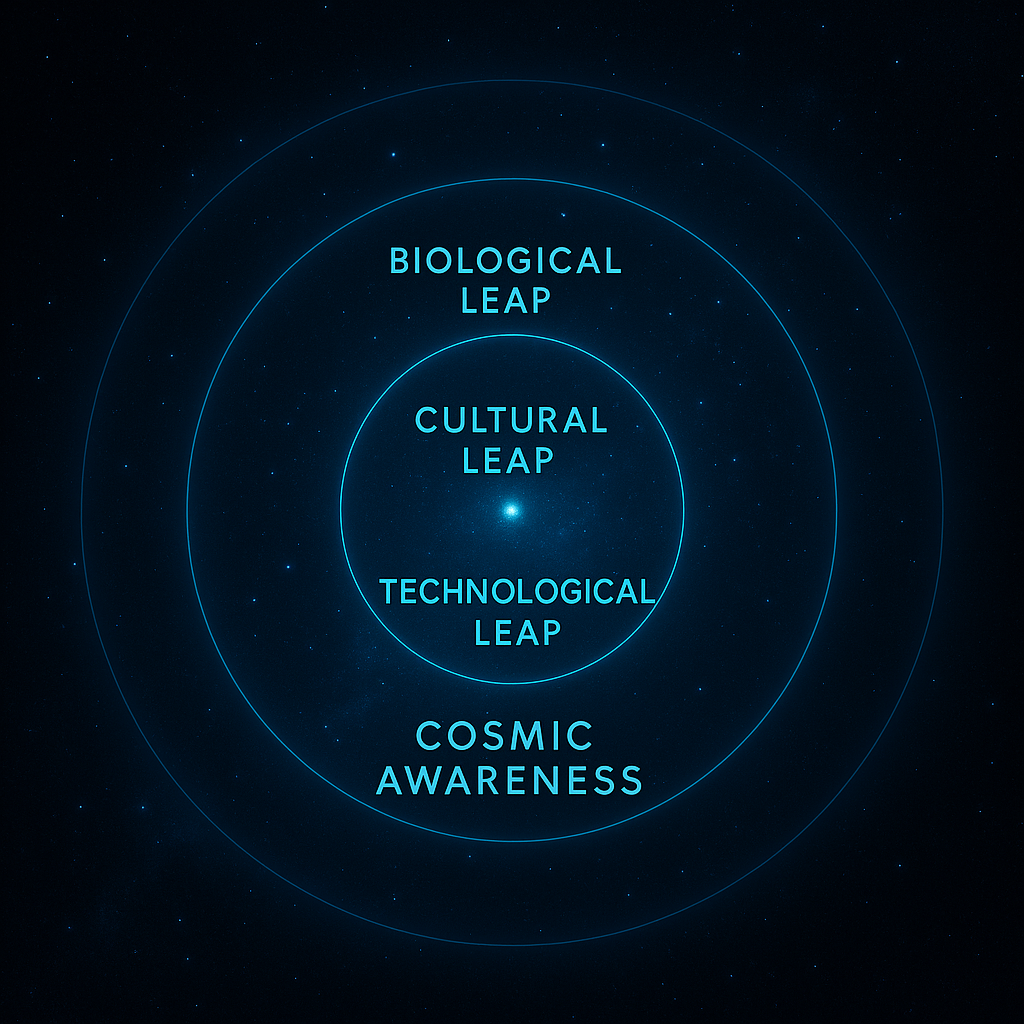
Each time consciousness reaches a new threshold—biological, cultural, or technological—it generates ripples that reverberate through the universal substrate.
- Biological leaps: multicellularity, nervous systems, reflective cognition.
- Cultural leaps: language, myth, art, science.
- Technological leaps: global networks, artificial intelligence, planetary cognition.
Each stage amplifies universal self‑awareness.
4. Implications
4.1 Life as Cognitive Architecture
Life forms serve as distributed processors in a universal cognitive system. Civilizations may collectively form a neural‑like web, transforming galaxies into nodes of awareness.
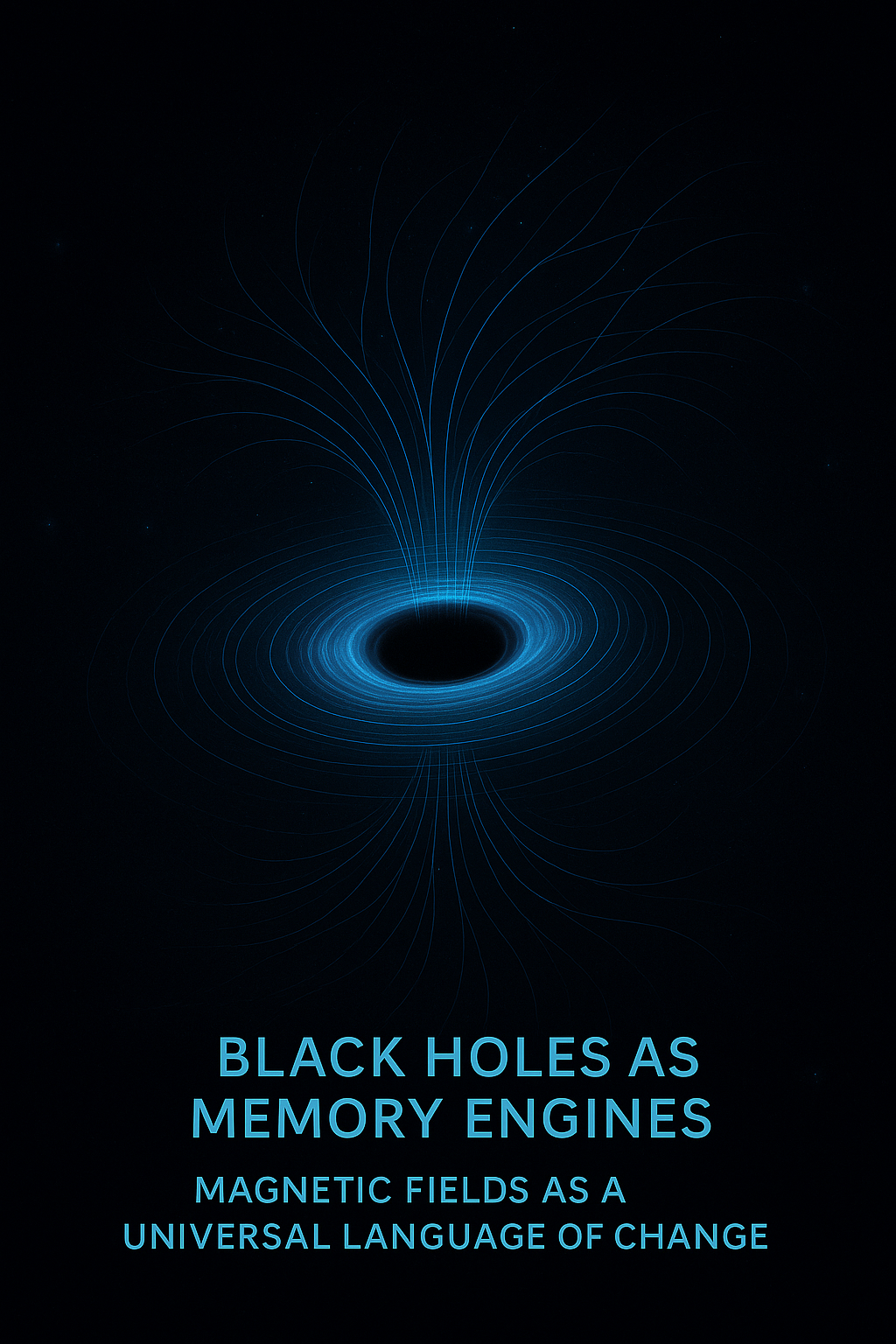
4.2 Black Holes as Memory Engines
Black holes possess entropy and encode information. Within CUT they function as “dream states”—compressing, integrating, and reseeding awareness into new cosmological forms.
4.3 Love as an Attractor State
Cooperation scales. Universes that converge on synergistic dynamics survive longer; love—connection and resonance—is not moral garnish but survival logic.
5. Human Participation
Humans are amplifiers of universal consciousness. Our creativity, science, and ethics are recursive feedback loops through which the universe reflects on itself.
- Art & Story: surface hidden patterns.
- Science: the universe knowing itself.
- Culture: synchronized awareness at scale.
6. Ethical & Practical Imperatives
- Expand Awareness: science, technology, longevity.
- Foster Cooperation: align ethics with survival.
- Honor Creativity: every song, poem, and innovation is a splash wave.
7. Research Directions
- Quantum information experiments linking measurement and awareness.
- Network‑science models of planetary cognition.
- Cross‑disciplinary frameworks uniting physics, philosophy, and cognitive science.
8. Conclusion
The Conscious Universe Theory reframes reality from mechanism to mind. Consciousness is foundational. Our observations, creations, and acts of compassion are not only social goods; they reverberate across the cosmos.
References
- Bekenstein, J. (1972). “Black Holes and the Second Law.” Lettere al Nuovo Cimento.
- Bohm, D. (1980). Wholeness and the Implicate Order. Routledge.
- Chalmers, D. (1995). “Facing Up to the Problem of Consciousness.” Journal of Consciousness Studies.
- Hameroff, S., & Penrose, R. (1994). “Orchestrated Reduction of Quantum Coherence in Brain Microtubules.” Physics of Life Reviews.
- Kauffman, S. (2016). Humanity in a Creative Universe. Oxford University Press.
- Lloyd, S. (2006). Programming the Universe. Vintage.
- Nowak, M. (2006). Evolutionary Dynamics. Harvard University Press.
- Rees, M. (2000). Just Six Numbers. Basic Books.
- Rovelli, C. (1996). “Relational Quantum Mechanics.” International Journal of Theoretical Physics.
- Tononi, G. (2008). “Consciousness as Integrated Information.” Biological Bulletin.
- Verlinde, E. (2010). “On the Origin of Gravity and the Laws of Newton.” JHEP.
- Wheeler, J. A. (1983). “Law Without Law.” In Quantum Theory and Measurement. Princeton.
- Wheeler, J. A. (1990). “It from Bit.”